🌿 Tulsi (Holy Basil)
Ocimum tenuiflorum
Tulsi, also known as Holy Basil, is an aromatic perennial or short-lived shrub belonging to the mint family, Lamiaceae. It is widely cultivated in South Asia and is especially well known for its deep cultural, traditional, and religious importance in Hindu communities.
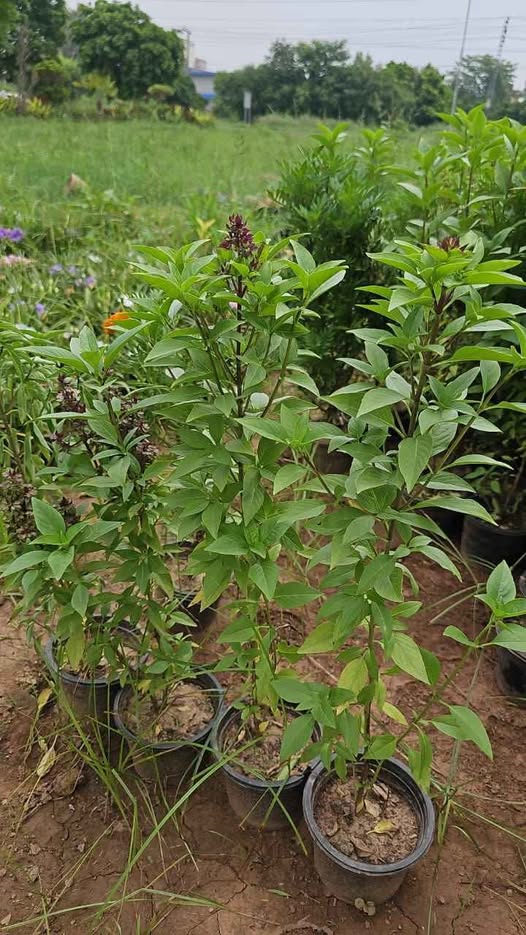
🌿 Botanical Information
Tulsi is scientifically known as Ocimum tenuiflorum. The species has also historically been referred to by the scientific name Ocimum sanctum.
It belongs to the genus Ocimum and the mint family, Lamiaceae. The plant is strongly aromatic because its leaves and other parts contain volatile compounds.
Scientific Classification
- Kingdom: Plantae
- Family: Lamiaceae
- Genus: Ocimum
- Species: Ocimum tenuiflorum
- Older scientific name: Ocimum sanctum
- Common names: Tulsi, Holy Basil, Sacred Basil
- Plant type: Aromatic herb or small shrub
🌱 Description of Tulsi
Tulsi is an upright, branching aromatic plant that commonly grows as a small shrub. Depending on the variety and growing conditions, plants can reach several tens of centimetres in height.
The stems are often branched and may become somewhat woody toward the base as the plant matures.
The leaves are generally opposite and aromatic, while the small flowers are arranged in elongated flowering structures.
🌍 Native Region and Distribution
Tulsi is associated with tropical and subtropical regions of Asia and is especially widespread in the Indian subcontinent.
It is now cultivated in many other warm regions of the world as an aromatic, medicinal, ornamental, and culturally important plant.
Tulsi can grow in home gardens, containers, temple gardens, farms, and other cultivated environments.
📜 History and Traditional Importance
Tulsi has a long history of cultivation and traditional use in South Asia.
It has an important place in Ayurveda and other traditional systems of knowledge, where different preparations of the plant have been used for generations.
Beyond its traditional uses, Tulsi has become one of the most recognizable sacred plants associated with Hindu culture.
🕉️ Tulsi in Hindu Tradition
Tulsi is regarded as a sacred plant in Hinduism and holds a special place in many Hindu households and religious traditions.
🌿 Sacred Plant
Tulsi is traditionally associated with purity, devotion, and spiritual practice. Many Hindu families maintain a Tulsi plant in or near their homes and include it in daily worship and religious observances.
Tulsi is also traditionally associated with the goddess Vrinda and with Lord Vishnu in Hindu religious traditions.
Religious practices involving Tulsi vary among Hindu communities, regions, and traditions.
🌿 Common Types of Tulsi
Several cultivated forms and traditional types of Tulsi are known in South Asia. Their appearance, leaf colour, aroma, and chemical composition can differ.
Rama Tulsi
Rama Tulsi generally has green leaves and is widely cultivated as a household and sacred plant.
Krishna Tulsi
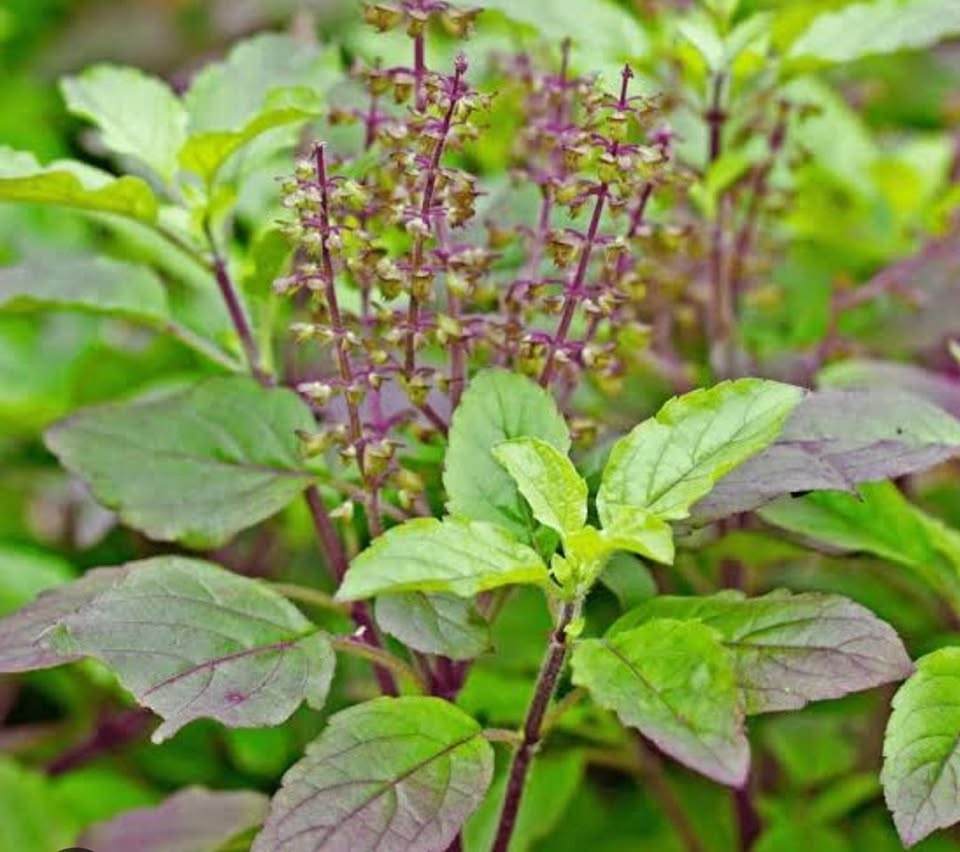
Krishna Tulsi is commonly associated with darker purple or purplish coloration in portions of the stems and leaves.
Vana Tulsi
Vana Tulsi is a commonly used name for a green-leaved form or type associated with a more wild or forest-like habit.
Names and classifications of Tulsi types can vary among sources and traditional cultivation systems.
🍃 Tulsi Leaves
Tulsi leaves are arranged oppositely along the stem. They are generally oval to elliptical and may have toothed margins.
The leaves are strongly aromatic and are one of the easiest characteristics to notice when identifying the plant.
Leaf colour can range from green to green with purplish tones, depending on the type or cultivar.
🌸 Tulsi Flowers
Tulsi produces small flowers arranged in elongated clusters.
Flowers can be white, pinkish, or purplish depending on the plant type.
As a member of the mint family, Tulsi has flowers with a characteristic structure associated with Lamiaceae.
🌿 Aroma and Essential Oils
One of the defining characteristics of Tulsi is its strong, distinctive aroma.
The leaves contain essential oils and other volatile compounds. Their composition varies among Tulsi types and can be influenced by genetics, climate, soil, and cultivation conditions.
Compounds reported from different Tulsi varieties include eugenol, linalool, methyl eugenol, and other aromatic constituents, although their proportions can differ substantially.
🌿 Traditional Uses
Tulsi has been used traditionally in South Asian cultures in herbal preparations, teas, infusions, and other forms.
Different plant parts have been used in traditional practices for a variety of purposes, including general wellness and seasonal preparations.
Traditional Knowledge
Tulsi has a long history in Ayurveda and other traditional practices. Traditional use reflects cultural knowledge and should be distinguished from modern clinical evidence.
❤️ Potential Health Benefits and Research
Tulsi has been studied for its phytochemical composition and possible biological activities.
Experimental research has investigated antioxidant, antimicrobial, anti-inflammatory, and other properties of Tulsi extracts and essential oils.
Some human studies have also investigated Tulsi preparations in relation to stress, metabolic health, and other outcomes. However, the strength of evidence varies according to the preparation, dose, study design, and health outcome.
Tulsi should not be presented as a proven treatment or cure for disease solely on the basis of laboratory or traditional evidence.
🧪 Chemical Constituents
Tulsi contains a diverse mixture of naturally occurring phytochemicals.
Depending on the variety and plant part, reported compounds include phenolic compounds, flavonoids, terpenoids, and volatile oil constituents.
Eugenol is one of the well-known aromatic compounds reported in some Tulsi essential oils.
Chemical composition can vary considerably between varieties and growing conditions.
🔬 Scientific Background
Tulsi has attracted scientific interest because of its traditional importance and its diverse phytochemical composition.
Researchers have investigated extracts, essential oils, leaves, seeds, and other plant material in laboratory, animal, and human studies.
Research findings should be interpreted according to the quality and limitations of individual studies. Results obtained from laboratory experiments do not automatically establish clinical benefits in humans.
🌱 Cultivation
Tulsi is relatively easy to cultivate in warm conditions and is commonly grown in home gardens and containers.
It generally performs well in sunlight and fertile, well-drained soil.
Regular watering can support healthy growth, although excessive water and poorly drained soil can damage the roots.
Pinching or pruning the growing tips can encourage branching and produce a bushier plant.
🌱 Propagation
Tulsi can commonly be propagated from seeds. Under suitable conditions, seeds germinate and develop into young plants.
Some cultivated types can also be propagated vegetatively using stem cuttings.
Propagation methods may vary according to cultivar, climate, and cultivation goals.
🌍 Ecological Importance
Tulsi flowers can provide nectar and pollen resources for bees and other insects.
Like other flowering plants, Tulsi can contribute to small garden ecosystems by supporting pollinating organisms.
Growing aromatic and flowering plants such as Tulsi can also increase plant diversity in home gardens and cultivated spaces.
🔎 How to Identify Tulsi
Tulsi can usually be recognized by its aromatic leaves, branching habit, opposite leaf arrangement, and elongated flower clusters.
- Strongly aromatic leaves
- Opposite leaf arrangement
- Oval to elliptical leaves
- Often toothed leaf margins
- Highly branched growth habit
- Small flowers arranged in elongated clusters
- Green or purplish coloration depending on type
- Characteristic mint-family appearance
For accurate identification, examine the leaves, stems, flowers, aroma, growth habit, and geographic location together.
🕉️ Cultural Significance
Tulsi is one of the most culturally significant plants in Hindu tradition.
In many Hindu households, the Tulsi plant is maintained as a sacred living plant and may be placed in a dedicated area for worship.
Tulsi is associated with devotion and with traditions connected to Vishnu and Lakshmi. Religious stories and practices surrounding Tulsi vary across Hindu traditions.
☀️ Environmental Adaptation
Tulsi is adapted to warm climates and generally grows actively during warm seasons.
It can be cultivated in tropical and subtropical environments and can also be grown as a seasonal plant in cooler regions.
Adequate sunlight, suitable temperatures, drainage, and regular moisture are important for healthy growth.
🌿 Why Tulsi Is Important
Tulsi is important because it connects several areas of plant science and human culture.
- Important sacred plant in Hindu traditions
- Long history in Ayurvedic traditions
- Source of aromatic plant compounds
- Popular home-garden plant
- Valuable to pollinating insects
- Subject of modern phytochemical research
- Important example of cultural plant knowledge
🌱 Conservation
Tulsi is widely cultivated and is not generally treated as a rare plant species.
Maintaining genetic diversity among cultivated types and conserving traditional knowledge about culturally important plants can nevertheless be valuable.
Growing plants responsibly and maintaining diverse home and community gardens can contribute to broader plant awareness and appreciation.
⚠️ Important Information
Tulsi has a long history of traditional use, but traditional use should not automatically be interpreted as proof that a preparation can prevent or cure a medical condition.
The chemical composition of Tulsi products can vary according to species or variety, growing conditions, plant part, and preparation method.
People who are pregnant, taking medication, preparing for surgery, or managing a medical condition should consult a qualified healthcare professional before using concentrated herbal preparations.
🌿 Tulsi at a Glance
- Common name: Tulsi / Holy Basil
- Scientific name: Ocimum tenuiflorum
- Family: Lamiaceae
- Plant type: Aromatic herb or small shrub
- Important feature: Strongly aromatic foliage
- Cultural importance: Sacred plant in Hindu traditions
- Traditional importance: Widely used in Ayurvedic and other South Asian traditions