🌿 Sandalwood
Santalum album
Sandalwood is an aromatic tree valued for its fragrant heartwood and essential oil. It has a long history of cultural, religious, cosmetic, and traditional use, particularly across South and Southeast Asia.
🌿 Botanical Information
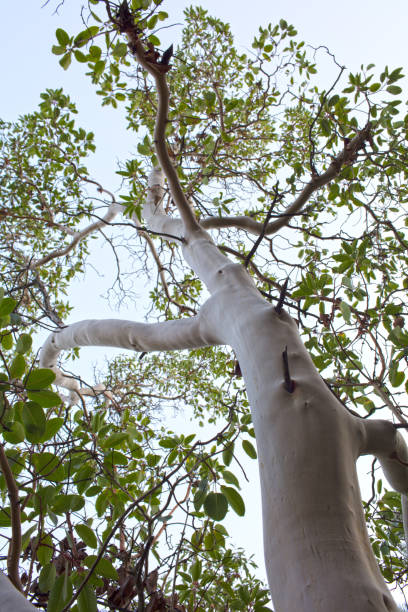
Sandalwood, scientifically known as Santalum album, is a small to medium-sized tree belonging to the family Santalaceae.
The species is particularly valued for the aromatic heartwood found within mature stems and roots. Sandalwood is also notable because it is a hemiparasitic plant that obtains water and nutrients partly through connections with the roots of other plants.
Scientific Classification
- Kingdom: Plantae
- Family: Santalaceae
- Genus: Santalum
- Species: Santalum album
- Common names: Sandalwood, Indian sandalwood
🌳 Description of the Sandalwood Tree
Sandalwood is an evergreen or semi-evergreen tree with relatively slender branches and smooth greyish to brown bark. Its leaves are simple, opposite, and generally oval to lance-shaped.
The flowers are small and may change in colour as they mature. Fruits develop after flowering and become dark purple to nearly black when mature.
The most valuable part of the tree is its aromatic heartwood, which develops gradually as the tree matures.
🌍 Native Region and Distribution
Santalum album is native to parts of South and Southeast Asia, with historical populations particularly associated with India and surrounding regions.
The species has been cultivated outside its original range in several tropical regions because of the high value of its aromatic heartwood and oil.
Sandalwood generally requires a warm climate and suitable host plants for successful development because of its hemiparasitic growth habit.
📜 History and Cultural Importance
Sandalwood has been valued for centuries for its fragrance and aromatic wood. It has played an important role in cultural, religious, ceremonial, and artistic traditions across Asia.
Sandalwood paste has traditionally been prepared by rubbing sandalwood against a smooth surface with a small amount of water. The resulting fragrant paste has been used in various cultural and personal-care practices.
The distinctive fragrance of sandalwood has also made its oil an important ingredient in perfumes, incense, cosmetics, and other aromatic products.
🌿 Traditional Uses
Sandalwood has a long history of traditional use in South Asian systems of knowledge and cultural practices.
Traditional Knowledge
Sandalwood and sandalwood preparations have traditionally been used for their fragrance, cooling sensation, personal-care practices, religious ceremonies, incense, and other cultural purposes.
Traditional use should be distinguished from modern clinical evidence. Historical use alone does not establish that sandalwood is an effective treatment for a medical condition.
🧴 Sandalwood Essential Oil
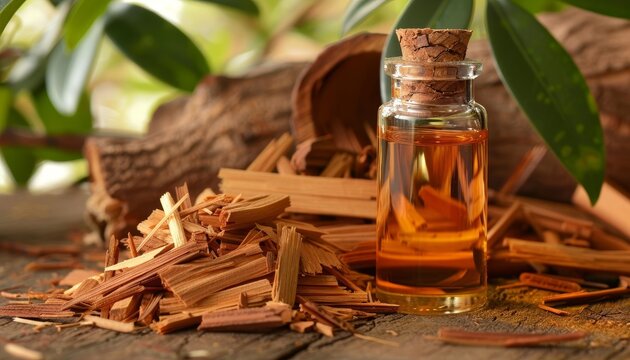
Sandalwood essential oil is obtained primarily from the heartwood of the tree through distillation.
The oil is known for its characteristic warm, woody, and persistent fragrance and has been widely used in perfumery, cosmetics, aromatics, and cultural products.
Sandalwood oil is a concentrated preparation and should not be considered equivalent to ordinary external use of sandalwood wood or paste.
🧪 Chemical Constituents
Sandalwood heartwood contains a range of naturally occurring aromatic compounds.
The characteristic fragrance of Santalum album is strongly associated with sesquiterpene alcohols, particularly α-santalol and β-santalol.
These compounds are important contributors to the distinctive fragrance and are among the constituents studied in sandalwood research.
🔬 Scientific Research
Sandalwood and its essential oil have been investigated in laboratory and other scientific studies because of their aromatic constituents and biological properties.
Research has examined sandalwood compounds in areas including fragrance science, microbiology, skin-related research, and natural-product chemistry.
Laboratory findings do not automatically demonstrate that a sandalwood preparation can prevent or cure a disease in humans. Evidence should be evaluated according to the preparation and the specific research question.
🕊️ Cultural and Religious Significance
Sandalwood has significant cultural importance in several Asian traditions. Its fragrance has traditionally been associated with purification, ceremony, meditation, and sacred spaces.
Sandalwood paste, incense, and aromatic wood have been used in various religious and cultural contexts for centuries.
These practices represent cultural and historical significance rather than evidence of a medical effect.
💼 Economic Importance
Sandalwood is a high-value natural resource because of the quality and fragrance of its mature heartwood and essential oil.
Sandalwood products are used in perfumery, cosmetics, incense, traditional products, handicrafts, and other industries.
The high commercial value of sandalwood has historically contributed to intensive harvesting and pressure on wild populations.
🌱 Conservation
Conservation of sandalwood is important because mature trees take many years to develop valuable heartwood and because unmanaged harvesting can place pressure on natural populations.
Sustainable cultivation, regulated harvesting, protection of natural populations, and responsible management are important for the long-term conservation of sandalwood resources.
Local conservation regulations should be followed when growing, harvesting, transporting, or trading sandalwood.
🌱 Cultivation
Sandalwood has a distinctive cultivation requirement because it is a hemiparasitic tree. Young sandalwood plants benefit from suitable host plants whose roots can support the sandalwood's nutrient and water requirements.
Warm conditions, suitable soil, sunlight, and appropriate host plants are important factors in successful cultivation.
Because valuable heartwood develops slowly, sandalwood cultivation requires long-term planning and responsible management.
🔎 How to Identify Sandalwood
Sandalwood can be identified using a combination of its leaves, flowers, fruits, bark, growth habit, and characteristic aromatic heartwood. Identification should ideally be confirmed using botanical characteristics rather than fragrance alone.
- Small to medium-sized tree
- Smooth greyish or brownish bark
- Opposite simple leaves
- Small inconspicuous flowers
- Dark fruits when mature
- Distinctively fragrant mature heartwood
🌍 Environmental Importance
Sandalwood contributes to tropical and subtropical ecosystems and interacts with other plants through its hemiparasitic root system.
Responsible cultivation can help reduce pressure on wild populations while maintaining a source of sandalwood products.
⚠️ Important Information
Information on this page is provided for educational purposes only. Traditional uses and descriptions of scientific research should not be interpreted as medical advice.
Sandalwood essential oil is a concentrated preparation and should be used appropriately. Avoid ingesting essential oils unless specifically directed by a qualified professional.
Sandalwood harvesting and trade may be regulated in different countries. Always follow applicable local conservation laws.
🔬 Why Study Sandalwood?
Sandalwood is important from botanical, ecological, cultural, economic, chemical, historical, and conservation perspectives.
Studying sandalwood helps us understand aromatic plants, natural products, traditional knowledge, sustainable forestry, plant interactions, and the importance of conserving valuable plant species.